
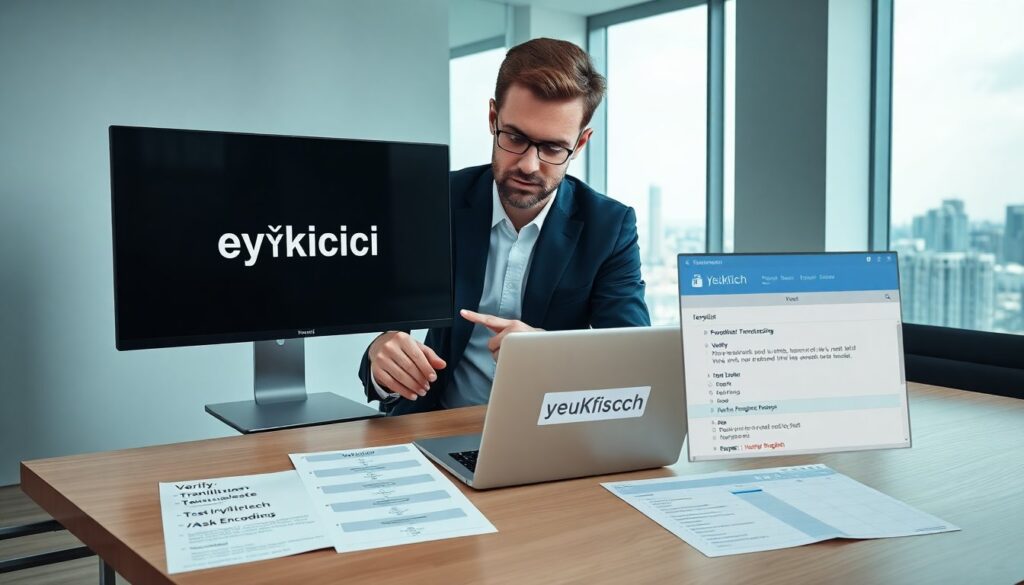
The word еукфищч appears in text and search results with no clear source. The reader sees it and wants to know what it means, how to say it, and how to use it. This guide gives a simple plan. It lists likely origins, provides a clear pronunciation method for English speakers, and shows practical steps for using the word in research and SEO.
Table of Contents
ToggleKey Takeaways
- The term еукфищч likely originates from Cyrillic script and may result from keyboard layout errors or encoding issues.
- Pronounce еукфищч as “yeu-kfish-chuh” with a slight stress on the first syllable for clear English phonetics.
- Verify unknown keywords like еукфищч by checking sources, keyboard maps, transliteration, and encoding before usage.
- In SEO, treat еукфищч as a low-frequency keyword and monitor its occurrences without investing heavily initially.
- Communicate with content authors to clarify the meaning or intent behind unusual tokens like еукфищч to avoid confusion.
- Follow systematic steps—verification, transliteration, encoding tests, searching, and tracking—to safely repurpose or manage unknown keywords such as еукфищч.
A Quick Hypothesis: Origins, Script, And Possible Means
The string еукфищч looks like Cyrillic script. The reader should note that some letters map to Latin letters visually but carry different sounds. The first hypothesis treats еукфищч as a transliteration artifact. It may appear when someone types on a keyboard set to Russian or Ukrainian instead of English.
Second, the string may represent a typo or encoding error. The user may have copied text from a page with mismatched character encoding. Text that uses UTF-8 can display as Cyrillic when the encoding tag is wrong. This error often produces sequences that look like random letters.
Third, the string may be a deliberate nonce word. A writer may create a short, pronounceable token for a test, a password, or a placeholder. In that case, еукфищч carries no lexical meaning but carries practical value as a unique identifier.
Finally, the string may hide another word through keyboard-layout shift. The user who typed on a Russian layout while intending English letters can produce predictable mappings. Checking keyboard maps often reveals the intended Latin word.
How To Pronounce And Transcribe “еукфищч” For English Speakers
To pronounce еукфищч, the reader should follow simple letter values from standard Russian transliteration. Transliteration produces roughly: e-u-k-f-i-sh-ch. The reader can say the sequence in three syllables: “yeu-kfish-chuh.” This form keeps sounds clear for an English ear.
A practical transcription uses Latin characters: yeukfishch. The reader sees that form and can test it aloud. The reader should stress the first syllable slightly. A neutral English stress pattern works: YEUK-fish-ch.
If the reader prefers a phonetic guide, use /jɛʊkˈfɪʃtʃ/ or plain spelling: yeuk-FISH-ch. The user can choose the version that feels natural in context. If the user needs a shorter form, they can use yeuk or fishch as an informal contraction.
When the reader documents the pronunciation, they should note uncertainty. The string lacks standard usage. The reader should label the pronunciation as provisional and update it if the source clarifies meaning.
Practical Uses: Handling Unknown Keywords In SEO, Research, And Communication
Search professionals see unknown tokens like еукфищч often. The first step is verification. The analyst checks whether the token appears in server logs, backlink lists, or search queries. The analyst runs the token through search engines and checks for context. This step tells whether the token is isolated noise or part of a pattern.
For SEO, the analyst treats the token as a low-frequency keyword until evidence says otherwise. The analyst does not waste resources on high-volume pages for a token without search volume. The analyst creates a watchlist and tracks queries that include the token. This method conserves time and reveals trends.
In research, the investigator captures surrounding text and metadata. The investigator checks timestamps, user agents, and referrers. The investigator tries alternative encodings and keyboard layouts. The investigator records each finding in a short log to avoid repeating steps.
In communication, the specialist asks the sender for clarification. A simple question resolves many cases: “Did you mean a different word, or was this intentional?” This question prevents misinterpretation and keeps the conversation efficient.
Below are clear steps the reader can follow to verify, translate, and repurpose unknown words.
Step-By-Step: Verify, Translate, And Repurpose Unknown Words
Step 1: Verify source. The user checks the original file, page, or message. The user notes encoding, font, and language tags. The user copies adjacent text for context.
Step 2: Check keyboard maps. The user opens a Russian-to-English key chart. The user types the Cyrillic string on a virtual keyboard and watches the Latin output. This test often reveals the intended English letters.
Step 3: Try transliteration. The user applies a standard transliteration table. The user converts each Cyrillic letter to a Latin equivalent. The user evaluates whether the transliterated form yields a real word or a recognizable name.
Step 4: Test encodings. The user opens the file in a text editor and switches encodings (UTF-8, Windows-1251, ISO-8859-1). The user looks for correct rendering. The user saves results and notes any changes.
Step 5: Search with variations. The user searches for the token, the transliteration, and likely typos. The user includes quotation marks and surrounding words. The user records matches and the URLs where the token appears.
Step 6: Ask the author. The user sends a short message asking for clarification. The user includes the exact token and any context. The user requests the intended spelling or meaning.
Step 7: Repurpose safely. If the token has no meaning and the user needs a placeholder, the user treats it as a unique ID. The user avoids using it in published content unless they label it as a test string.
Step 8: Track occurrences. The user adds the token to a monitoring tool or a simple spreadsheet. The user logs date, source, and any updates. The user reviews the log weekly.
These steps help the user handle еукфищч and similar tokens with minimal risk and clear outcomes.