
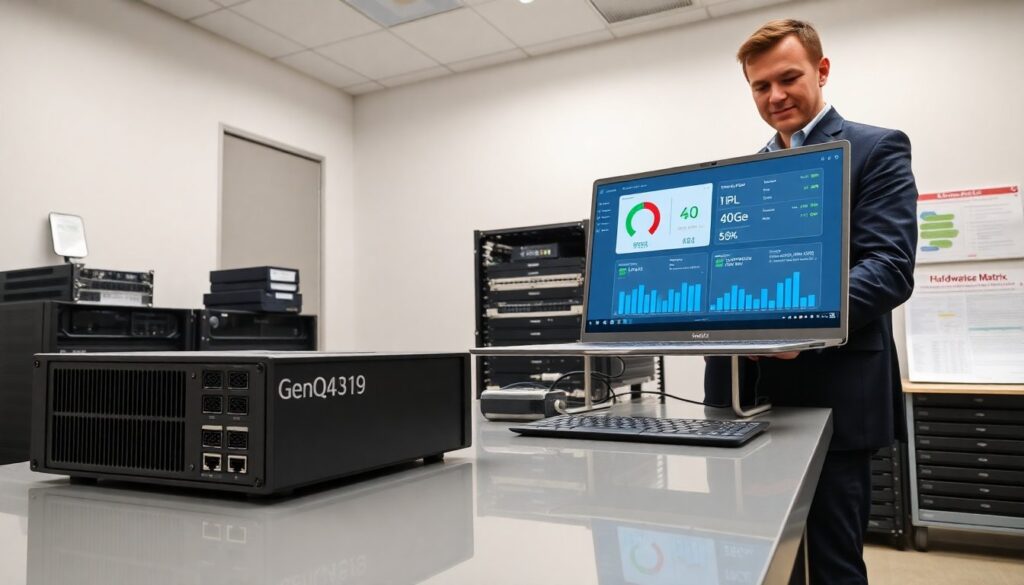
GenQO4319 is a modular processing unit that firms use for data filtering and low-latency inference. The device delivers steady throughput and low power draw. This article explains its features, core methods, and common setup steps. It aims to give clear, practical information for English-speaking users who must assess, deploy, or troubleshoot GenQO4319 systems.
Table of Contents
ToggleKey Takeaways
- GenQO4319 is a compact modular processing unit optimized for edge inference with variants tailored for standard, performance, and low-power needs.
- The device supports 8 to 16 compute cores, up to 64 GB low-latency memory, and PCIe 4.0, delivering steady throughput with low power consumption.
- GenQO4319 runs a microkernel with hardware acceleration for tasks like matrix multiplication and supports standard model formats such as ONNX for efficient inference.
- Typical deployment involves provisioning the OS image, deploying models via REST API or CLI, and monitoring performance with tuning options like thread adjustment and hardware acceleration.
- Users should verify firmware and driver compatibility, test network throughput, and apply recommended fixes for common issues like boot failures and latency spikes.
- Strong security features include secure boot, signed firmware, TPM 2.0 support, and detailed audit logs, ensuring device integrity and compliance.
What Is GenQO4319? Key Features, Specs, And Variants
GenQO4319 is a compact processing appliance. It targets edge inference, packet inspection, and sensor fusion tasks. The unit ships in three variants: GenQO4319-S (standard), GenQO4319-P (performance), and GenQO4319-L (low-power). Each variant uses the same core board. The P model uses a faster clock and larger cache. The L model uses power gating and scaled voltage.
The device lists a few standout specs. It offers 8 to 16 compute cores, 16–64 GB of low-latency memory, and a PCIe 4.0 interface. It supports dual 10GbE ports and a single 40GbE uplink on P and S models. The unit draws 25–75 W depending on the model and load. The vendor rates sustained throughput in inference mode at 3,000–12,000 inferences per second for common models.
GenQO4319 supports standard OS images. The vendor ships Ubuntu 22.04 LTS images with optimized drivers. It also supports a lightweight RTOS for deterministic tasks. The device includes built-in monitoring with a REST API and a hardware watchdog. Firmware updates use signed packages and a dual-bank update method. This method reduces update failures.
Customers choose GenQO4319 for predictable latency, small size, and long-term driver support. The P variant fits use cases that need higher throughput. The L unit fits battery-powered or fanless designs. The S model balances power and performance for mixed workloads. The device has a five-year maintenance window and commercial support options.
How GenQO4319 Works: Core Technology, Performance Characteristics, And Typical Workflows
GenQO4319 runs a microkernel that isolates I/O and compute tasks. The kernel assigns compute threads to physical cores. The device uses hardware acceleration for common primitives. It accelerates matrix multiply, vector dot, and fixed-point convolution. It also uses SIMD extensions for parallel data paths.
The system loads models in an optimized format. The loader validates a model checksum and maps model weights into memory. The runtime then compiles model graphs to native kernels. The runtime caches compiled kernels to reduce startup time. The device supports standard formats such as ONNX and a vendor-optimized binary format.
Performance scales with model size and batch configuration. Small batches favor latency. Larger batches favor throughput. The performance model gives predictable trade-offs. The vendor provides a bench tool that measures latency, throughput, and memory use. Engineers use this tool to pick the right variant and batch size.
Typical workflows follow three steps. First, users provision the device with a validated OS image. Second, users deploy model artifacts via the REST API or a vendor CLI. Third, users monitor metrics and apply tuning. Tuning steps include adjusting thread counts, selecting quantization levels, and enabling hardware acceleration for specific operators.
GenQO4319 handles mixed tasks in parallel. It assigns high-priority threads to time-sensitive workloads. It moves less sensitive tasks to background slots. This behavior preserves tail latency for critical requests. The device uses per-core thermal controls to avoid throttling under sustained load.
Security features include secure boot, signed firmware, and an audit log. The audit log records firmware updates, model loads, and key access events. The device supports TPM 2.0 for attestation. Administrators can integrate attestation with their provisioning server to validate device state.
Deployment, Compatibility, And Practical Troubleshooting Tips For English-Speaking Users
GenQO4319 fits rack, desktop, and field enclosures. The vendor lists mounting guides for standard 1U and DIY chassis. The device supports IPv4 and IPv6. It also supports VLAN tagging and basic QoS. The vendor provides drivers for common Linux kernels and a prebuilt image for Ubuntu 22.04.
Before deployment, users should verify firmware and driver versions. The vendor recommends matching OS images to firmware. Mismatched versions can cause driver failures or reduced throughput. The vendor supplies a compatibility matrix that lists supported kernel, driver, and firmware versions.
For network setups, users should test the 10GbE links with iperf3. They should test the 40GbE uplink where present. They should enable flow control if packet loss appears under load. Proper cabling and switch settings reduce jitter and dropped packets.
Common issues and fixes:
- Device fails to boot after update: Reboot into recovery and reflash the previous signed firmware image. The dual-bank system usually recovers the device.
- High latency on bursts: Reduce background thread counts and enable priority scheduling for time-sensitive threads.
- Driver module errors: Confirm kernel version and install vendor driver packages from the compatibility matrix.
- Model load failures: Verify model checksum and format. Convert unsupported models to ONNX before upload.
Monitoring tips: Enable the REST API and pull metrics every 30 seconds. Track CPU, memory, latency percentiles, and error counts. Set alerts for tail latency and thermal throttling events. The device exposes sensors for temperature and voltage.
Support channels: The vendor offers email and paid phone support. The vendor also hosts a community forum where users post logs and patches. For enterprise deployments, the vendor offers on-site assistance and SLAs. English-speaking users will find documentation and CLI examples in English on the vendor portal.
When users document a problem, they should include firmware, driver, kernel, model format, and a minimal reproduction step. Clear logs help engineers reproduce and fix issues faster. GenQO4319 users who follow these steps will reduce deployment friction and reach stable operation faster.